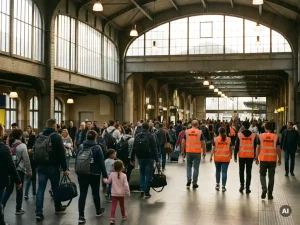
Political instability directly affects travel safety by increasing the likelihood of civil unrest, sudden border closures, infrastructure disruption, and targeted violence against foreign nationals. The risks are not theoretical, they can materialise within hours of a trigger event, turning a routine business trip into an emergency requiring immediate extraction. The sections below address the specific questions that travel risk managers and duty of care professionals most need answered.
What types of threats does political instability create for travelers?
Political instability creates a layered set of threats for travelers: civil unrest and protest activity, targeted or opportunistic violence, disrupted transport networks, restricted border access, and the breakdown of emergency services. These threats rarely appear in isolation. When a country’s political situation deteriorates, multiple risk categories tend to escalate simultaneously.
The most immediate danger is often civil unrest. Protests can turn violent without warning, and travelers caught in the wrong location at the wrong time face real physical risk even when they are not the intended target. Security forces may respond with crowd control measures that create additional hazards in the surrounding area.
Beyond street-level unrest, political instability frequently disrupts the infrastructure that travelers depend on. Airports may reduce operations or close entirely. Road checkpoints become more common and less predictable. Banking systems can freeze. Communication networks may be restricted by authorities seeking to limit coordination among opposition groups.
For business travelers specifically, there is also the risk of being perceived as politically affiliated with a foreign government or corporation. In some environments, foreign nationals become targets for kidnapping, detention, or harassment precisely because of their perceived access to resources or influence. High-risk country travel demands threat assessments that account for all of these dimensions, not just headline security events.
How quickly can a stable region become dangerous for business travelers?
A region that appears stable can become dangerous for business travelers within hours. A single triggering event, an election result, a military action, an assassination, or a large-scale protest response, can escalate into widespread unrest, infrastructure collapse, or active conflict faster than most standard travel risk management protocols can respond.
History provides consistent evidence of this. During the Arab Spring, countries that had been considered manageable travel destinations deteriorated rapidly over a matter of days. NGS supported movement operations in Egypt and Libya during this period, including the extraction of nearly 4,000 personnel from Libya alone. The speed of that deterioration left many organisations with little time to plan.
The same pattern repeated when Russia invaded Ukraine. Conditions changed not over weeks but over a single news cycle. Organisations that had no pre-existing evacuation framework found themselves scrambling for options that were already scarce. Those with pre-positioned plans and trusted operational partners were able to act immediately.
For travel risk professionals, the lesson is that stability is a condition, not a guarantee. A destination’s current threat level is only a starting point. What matters equally is how fast the situation can change and whether your organisation has the response infrastructure to act before options close.
What are the signs that political instability is worsening in a destination?
The signs that political instability is worsening in a destination include increased military or police visibility, restrictions on public gatherings, rising inflation and fuel shortages, government crackdowns on media, opposition arrests, and growing frequency of protest activity. These indicators often appear before major incidents and provide a critical window for proactive action.
Travel risk managers should monitor several categories of signal:
- Political signals: Emergency powers being invoked, constitutional disputes, leadership crises, or sudden changes in government
- Security signals: Increased military deployments, armed checkpoints, curfews, or reports of targeted attacks on government or foreign interests
- Economic signals: Currency collapse, bank withdrawal limits, fuel rationing, or supply chain disruptions that indicate systemic stress
- Social signals: Organised protest movements gaining momentum, inter-communal tensions rising, or significant increases in violent crime
- Operational signals: Airlines reducing or suspending routes, embassies issuing updated travel warnings, or international NGOs withdrawing staff
No single indicator is definitive on its own. The concern arises when multiple signals converge. A country experiencing political tension alongside economic stress and increasing security force activity is one where the risk trajectory is clearly moving in the wrong direction. Continuous threat monitoring and live country assessments are essential tools for detecting these patterns early enough to act.
How does political instability affect medical and emergency response capabilities?
Political instability significantly degrades medical and emergency response capabilities in affected regions. Hospitals may be overwhelmed, understaffed, or deliberately targeted. Ambulance services become unreliable. Supply chains for medication and medical equipment break down. In active conflict zones, healthcare infrastructure is often among the first systems to fail under sustained pressure.
For travelers requiring urgent medical attention in a politically unstable environment, these failures create compounding risk. A medical emergency that would be manageable in a stable country can become life-threatening when the local response system cannot function effectively. Evacuation to a facility capable of delivering appropriate care may be the only viable option, but political instability also affects the ability to execute that evacuation.
Border closures, airspace restrictions, and disrupted ground transport can make medical evacuation significantly more complex. During the Middle East crisis documented in NGS operational records, clients needed charter aircraft with capacity for up to 200 passengers per flight, alongside coordinated ground movements across multiple countries including Iraq, Kuwait, and the UAE. The medical dimension of those movements required the same level of planning as the security dimension.
Organisations sending employees to high-risk environments need to ensure that their emergency response provider can operate effectively when local systems cannot. That means having pre-positioned assets, trusted local networks, and the capability to move patients across borders when standard medical infrastructure is unavailable.
What duty of care obligations apply when sending employees to politically unstable regions?
Organisations have a legal and moral duty of care to assess, communicate, and mitigate the risks faced by employees traveling to politically unstable regions. This obligation exists under employment law in most jurisdictions and is reinforced by international guidance frameworks, including ISO 31030, which provides specific standards for travel risk management. Failure to meet this duty can result in legal liability, regulatory scrutiny, and serious reputational damage.
In practical terms, duty of care for high-risk country travel requires organisations to:
- Conduct pre-travel risk assessments that reflect current conditions in the destination
- Provide employees with clear, accurate pre-trip briefings covering specific threats and mitigation measures
- Maintain real-time visibility of employee locations throughout the trip
- Have a documented emergency response plan that includes evacuation options
- Ensure employees have access to 24/7 support from a qualified assistance provider
- Review and update risk assessments when the situation in a destination changes
The obligation does not end once a traveler departs. If conditions deteriorate mid-trip, the organisation remains responsible for taking appropriate action. Duty of care is a continuous responsibility, not a pre-departure checklist. Organisations aligned with ISO 31030 are better positioned to demonstrate that their travel risk management approach meets the standard of care expected by regulators and courts.
How should organisations respond when political instability escalates mid-trip?
When political instability escalates while employees are already in-country, organisations should immediately activate their emergency response plan, establish direct contact with all affected travelers, assess current and projected threat levels, and begin evaluating evacuation options before they become unavailable. Speed matters, the window for safe movement often closes faster than anticipated.
The response should follow a structured sequence:
Establish communication and confirm locations
The first priority is knowing where everyone is. Real-time traveler tracking removes the uncertainty that slows decision-making in a crisis. Once locations are confirmed, the organisation can assess which employees are in higher-risk areas and prioritise accordingly. Mass communication tools that allow simultaneous outreach to all affected travelers are essential at this stage.
Assess options before conditions narrow them
Every hour of delay in a deteriorating situation reduces the available options. Commercial flights may suspend operations. Border crossings may become congested or close entirely. Ground routes that were viable in the morning may not be viable by evening. Organisations need to evaluate what movement options exist now, not what they assume will still be available later. This requires live intelligence from people who understand the local environment, not just monitoring of public news sources.
During the Middle East crisis, NGS worked with trusted local providers who understood road conditions, border requirements, and practical constraints that do not appear in written plans. That local knowledge allowed the team to adjust routes in real time and scale transport capacity as the situation evolved. Hundreds of personnel and family members were moved without a single transit incident.
For travel risk professionals managing employees in Ukraine, similar principles apply. NGS teams have continued operating in Kyiv on a near-weekly basis, moving from Poland into Ukraine by road with armoured transport, live intelligence, and established contingency options. The lesson from that environment is that even highly complex, ongoing operations can be managed safely when the planning is thorough and the operational team is experienced.
The fundamental principle for mid-trip escalation is this: decisions made early, with good information and trusted partners, produce better outcomes than decisions made late under pressure. Organisations that wait for certainty before acting often find that the moment for safe action has already passed.
How NGS helps organisations manage travel safety in politically unstable regions
Northcott Global Solutions provides end-to-end travel risk management and emergency response support for organisations operating in complex, high-risk environments. Whether the threat involves civil unrest, political crisis, or rapid escalation, NGS delivers the operational depth to keep employees safe before, during, and after travel.
- Pre-travel risk assessments calibrated to current conditions in low-, medium-, and high-risk destinations
- 24/7 itinerary monitoring and traveler tracking through the Aurora platform, with live visibility across all in-country personnel
- Emergency response and evacuation covering medical, security, and crisis scenarios, with an average urban response time of 40 minutes or less
- Threat and vulnerability assessments to identify risks before they become incidents
- Close protection and secure ground transportation for executive and high-risk travel
- ISO 31030-aligned services to support organisations in meeting their duty of care obligations
NGS has a documented track record across some of the most demanding environments in the world, including Libya, Egypt, Ukraine, and the Middle East. If your organisation needs a travel risk management partner with the capability to respond when it matters most, contact NGS to discuss your requirements.
Related Articles
- How do you assess cybersecurity risks for employees travelling abroad?
- How do you evacuate employees from a conflict zone safely?
- What are the biggest risks faced by business travellers?
- How do you vet a local security provider in a high-risk destination?
- What is travel risk management and why does it matter?