Author: Kaia Oyuela-Villarreal
Since mid-September, protests that began over deteriorating school conditions in France have spread to 14 countries across Europe. This latest assessment goes beyond tracking dates and incidents to explain the unrest. It identifies five distinct strands, from student revolts and housing movements to copycat disorder, examines what drives each and why the least organised are the most violent, and sets out what to expect through the winter and into 2027.
Key Judgements
- It is highly likely that the risk of civil unrest across Europe remains elevated through November, with France as the epicentre and Spain, Italy and Belgium also highly exposed to disruption in the coming weeks. Elevated unrest is likely to continue into December.
- The wave is not one movement but a protest cycle of five overlapping strands, each with its own grievance, protest tactics and conditions under which it would subside.
- Violence is increasingly decoupled from the movement’s grievances and tends to rise as organisation falls: union strikes and housing campaigns disrupt but rarely turn violent, while loosely organised gatherings called online, exploited by opportunists and radical elements, produce most of the looting and arson, particularly after dark.
- 20 November is likely to be the peak of coordinated, transnational mobilisation, although further escalation in France after that date is a realistic possibility.
Situation
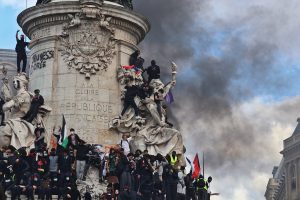
Since mid-September, protests have spread across 14 European countries, combining mass marches, strikes, protest camps and night-time rioting. What began as a local grievance at a Créteil lycée over dilapidated, overheated classrooms and a lack of teachers has spread to include looting and arson in Paris, tent camps in Madrid, dockworkers marching into Genoa’s port, and looted shopfronts in Frankfurt. At its first peak on 17 October, about 550,000 people marched across France as masked groups looted shops and burned Limoges town hall; turnout surpassed that on 5 November, with over 600,000 demonstrators. Five key themes and drivers are visible, and the less organised a strand, the more violent it tends to be (see figure).
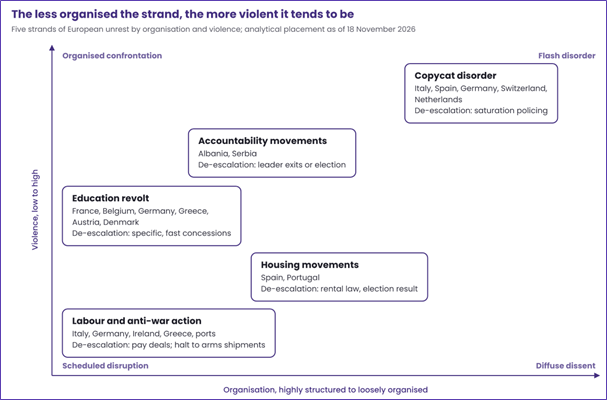
The education revolt: students against austerity (France, Belgium, Germany, Austria, Denmark, Greece): Cuts and freezes to education spending have made school and university students the initiators of this protest cycle. In France, school blockades over teacher shortages and building conditions have broadened into a revolt against the cost of living and a 2027 budget seeking EUR 54bn in savings. Belgium is the most confrontational case outside France, with 194 arrests in Liège in a single week of protests over university fees. In Germany, the ‘Gen Z regelt’ alliance brought over 100,000 people into more than 30 cities on 31 October in largely orderly daytime marches. Greek, Danish and Austrian student marches similarly passed mostly peacefully.
The housing movements (Spain, Portugal): Rents and evictions have driven the largest sustained mobilisation outside France. In Spain, the death of an evicted 87-year-old woman and Congress’ rejection of housing decrees triggered marches of tens of thousands of people and a snap election for 29 November. In Portugal, police have cleared protest camps in Lisbon and Porto three times since 20 October, and protesters have returned each time.
Copycat disorder (Italy, Switzerland, the Netherlands, and strands in Spain and Germany): Anonymous online networks, such as Spain’s ‘Blocus’, have called gatherings that borrow French imagery and slogans, often with no articulated demand. In Italy, a cost-of-living march in Milan on 17 October ended in two days of rioting and looting around Piazza del Duomo, with clashes spreading to Bologna and Turin. Italian reporting indicated some participants were mobilised online to emulate France. In Barcelona on 24 October, a Blocus gathering produced 128 arrests, 72 of them under 18. On 31 October, far-left fringe groups erected burning barricades in Zurich, Basel and Geneva; meanwhile The Hague recorded 34 arrests, mostly teenagers, and night-time looting in Frankfurt left more than 100 officers injured after an otherwise peaceful daytime march.
Accountability movements (Albania, Serbia): These movements seek to remove governments rather than reverse individual policies. Albania’s student-led protests against PM Edi Rama have produced more than 300 injuries on 24 October alone. Serbia shows an alternative endpoint: two years of student protest culminated in an electoral victory on 25 October, with Aleksandar Vučić conceding.
Labour and anti-war action (Italy, Germany, Ireland, Greece, the Mediterranean port network): Organised labour and youth groups are combining material demands with opposition to military rearmament, while the pro-Palestine movement has driven the campaign against arms shipments to Israel. Italy saw more than 255,000 people marching in over 40 cities during a union-led general strike on 30 October, when public transport was limited and protesters blocked ring roads in Milan and Bologna. The same day, dockworkers in 22 countries struck against arms transport. About 15,000 people marched into the port of Genoa and ferries stayed docked at Piraeus. In Germany, school students have held four nationwide strikes this year against the gradual return of military service.
Analysis
The underlying driver of the protests is relative deprivation: a generation that expected education and employment to deliver economic security no longer believes they will. Eurozone prices rose by about 23% between 2020 and 2025, and energy costs linked to the Middle East war have pushed inflation higher again this autumn. Housing is the most acute pressure point: average rent in Spain is equivalent to about 99% of a young person’s average salary, while Portuguese house prices have more than doubled since 2017. Grievance alone, however, does not explain the timing of the unrest. Two key mechanisms are in effect. First, moral shocks, moments of public outrage, converted frustration into action, notably the eviction of 87-year-old Maricarmen Abascal in Madrid and a 15-year-old losing a hand to a police grenade in Lens, France. Second, activists have linked school conditions, rents, fuel prices and rising defence spending into a single narrative, summed up by the youth strike slogan ‘fight for our future, not their wars’. This bridging allows students, unions, housing campaigners and Palestine solidarity groups to mobilise together despite limited shared demands. Portraying the latter as infiltrators, as some governments and media outlets have done, is part of a wider contest over what the protests represent.
The political opportunity structure is unusually open. Fragmented parliaments and fragile coalitions in France, Spain and Belgium signal divided political elites, weakening governments’ ability to offer credible concessions or a united counter-narrative to the protesters’ framing. Elections in Spain, France and Italy widen the window, while parliamentary deadlock over budgets makes the street the main arena of contention.
State responses have shifted from negotiated management towards strategic incapacitation, with mixed results. France deployed about 70,000 police on consecutive weekends, imposed localised curfews and banned gatherings in parts of city centres. Weekend turnout and damage fell, but officers were targeted with incendiary devices on 31 October and more than 770 people were arrested. Italy deployed 500 troops to Milan. Heavy policing is a double-edged sword: it is containing disorder for the moment (Barcelona’s 700-officer cordon on 31 October prevented a repeat of 24 October), but a serious injury or death caused by police heavy-handedness remains a trigger for renewed unrest.
What makes this cycle unusual is its speed, reach and structure. First, it has reached wealthy, stable states such as Switzerland, Germany and Denmark. Second, diffusion runs on imitation rather than organisation. This is connective rather than collective action: people join by sharing content through personal networks, not through unions or activist groups, which lets tactics and imagery spread within days but makes the movement harder to sustain or to negotiate with. The French government has acknowledged intelligence failures before 17 October, having treated weeks of school blockades as a local education dispute rather than the start of a national movement. Third, youth networks and unions mobilise in parallel without shared structures, making the movement easier to hijack. Finally, the radical element is increasingly detached from the grievance: online messages in Spain discussed reselling stolen goods, and Swiss calls explicitly encouraged property damage. Russia, Iran and others are likely to amplify footage of disorder, but there is currently no evidence of foreign orchestration.
Protester profiles
The aggrieved generation: School pupils, students and young renters, the initiators of the cycle and the core of the education and housing themes. Their repertoire is blockades, occupations and walkouts, and they are overwhelmingly peaceful. Concessions can demobilise them, but only if specific and fast. They are likely to comprise most of the turnout on 20 November.
The organised workforce: Unions, public-sector staff and dockworkers, with strong mobilising structures and a routinised, notice-based repertoire. They cause the most economic disruption and the least violence, and are the most open to negotiation: Ireland suspended a second strike once pay talks began.
The allied movements: Palestine solidarity, anti-war, and climate groups with their own mobilising structures and triggers, bridged into the cycle through opposition to rearmament. They target supply chains rather than shops: ports, defence firms and arms shipments. Their militant edge is direct action, such as red paint at Denmark’s Terma defence plant in August, not looting.
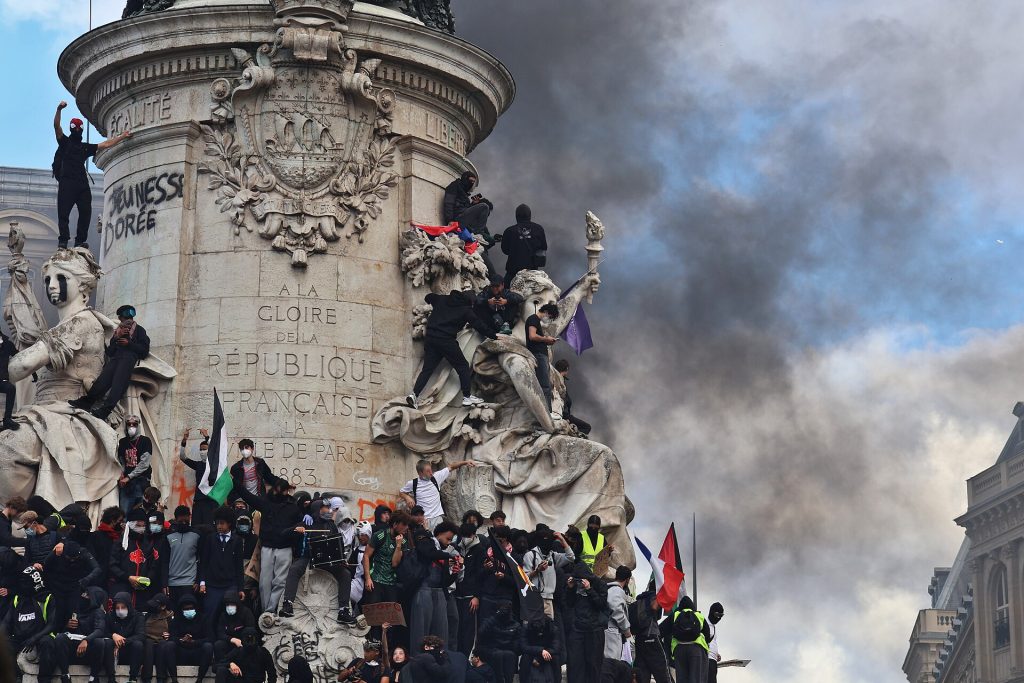
The hijackers: Opportunistic looters, masked radical elements and ‘riot tourists’ who operate at the tail of marches and after dark, targeting luxury retail, supermarkets, banks and town halls. Concessions do not move them; policing does. They pose the principal threat to commercial premises and staff in city centres and are the reason violence is likely to continue even if grievances ease.
The counter-mobilisers: Far-right groups, football ultras and, in the Balkans, state-aligned enforcers, often claiming to ‘protect’ shopkeepers. They turn protest-versus-police violence into group-versus-group clashes, and their weight will grow if far-right parties win in Spain or France.
Assessment
Unrest is highly likely to persist through November and is increasingly shifting towards strike-driven disruption of transport, ports and public services. French turnout reached a new high of about 600,000 on 5 November, when unions held a cross-sector strike, but weekend marches have since shrunk to about 146,000 on 7 November and 106,000 on 14 November (Interior Ministry). Street mobilisation is fading while union-led action holds up. When the cycle declines, it is likely to do so unevenly, as early groups fade and later arrivals take up existing grievances for their own causes.
Education revolt: The National Assembly rejected the budget at first reading on 4 November, 458 votes to 0, and the Senate votes on the government’s original text on 9 December. It is likely that the government will force the budget through without a vote when it returns to the Assembly, which would expose it to censure motions in which the far-right National Rally party’s votes are decisive. Final adoption is not expected before the 17 December deadline, and last year’s precedent suggests the budget process could extend into January. Students rejected a EUR 4bn education offer, so renewed escalation around the 20 November youth strike is a realistic possibility. Germany’s Gen Z regelt alliance plans to join the 20 November youth strike.
Housing movements: Spain’s 11 November general strike caused widespread but uneven disruption: about 5% of flights were cancelled, unions reported stoppages of around 90% at the ports of Valencia and Algeciras, and road blockades hit Catalonia, the Basque Country, Andalusia and Valencia. The Interior Ministry recorded more than 900 incidents and over 50 arrests. If the 29 November election produces a government including Vox, sustained protests by unions, the housing movement and Catalan and Basque groups are highly likely. Portugal’s camps are likely to keep re-forming around the final vote on the rental bill, scheduled for 24 November; protesters re-established a camp in Lisbon’s Praça dos Restauradores on 15 November.
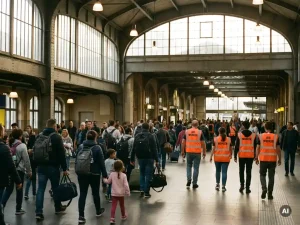
Copycat disorder: Online calls for action already target 30 November in 12 Spanish cities, and further gatherings in Italian, German, Swiss and Dutch cities are likely around 20 November. Turnout is the key uncertainty. Disorder is likely to concentrate after dark, once daytime marches disperse, as in Frankfurt on 31 October, exposing retail, hospitality and transport operators in commercial districts and around main stations to short-notice closures and property damage.
Accountability movements: Recurring weekend clashes in Tirana are highly likely while Rama stays; protester fatigue may produce temporary lulls rather than demobilisation. Protesters rejected Rama’s offer of dialogue in November, and activists have called on the diaspora to return to Tirana for protests on 28 and 29 November. In Serbia, renewed mass unrest in the outlook window is unlikely.
Labour and anti-war action: Italy faces general strikes on 20-21 and 28 November, the former coinciding with the international youth strike, and Belgium faces a week of industrial action from 23 November that is likely to disrupt rail and public transport significantly. Further port stoppages are likely while wage talks continue and arms shipments remain contested. In Germany, a fifth school strike against military service is planned for 20 November, a week before the Bundestag votes on a budget raising defence spending while cutting education. A major Israeli escalation in Gaza, the West Bank or Lebanon would act as a wildcard, rapidly reviving this strand.
What would change the dynamic
Escalators: A protester death, which in France could trigger suburban riots like those of 2023; heavier public order operations; forced adoption of the French budget; a PP-Vox government; viral footage of disorder before 20 November; or an energy-price shock this winter.
De-escalators: Targeted education concessions that students accept; the winter holiday lull; negotiated pay settlements; and saturation policing on dates named in online calls for protest.
Indicators and warnings: Online calls for protest translating into turnout; explicit incitement before an event; strikes announced alongside demonstrations (a sign of scale shift); blockades of ports, fuel depots or rail hubs; and threats naming specific businesses or executives.
Forecast
Immediate term (November): Disruption is highly likely to peak. General strikes in France, Italy and Belgium, the 20 November youth strike and Spain’s 29 November election all fall within the coming weeks.
Short term (December-January): A partial lull is likely as budgets move through parliament and the holiday period sets in. In France, the 2018-19 yellow vest and 2023 pension reform protests each persisted for several months before fading, which points to gradual decline rather than resolution. Renewed mobilisation in January, as austerity measures take effect, is a realistic possibility.
Longer term (to mid-2027): The trajectory depends on two uncertainties: whether governments offer meaningful concessions, and whether protest networks can build the organisational capacity to sustain mobilisation. Building that capacity means framing the grievance convincingly against official counter-narratives and turning online calls for protest into organised turnout. Convergence between youth networks and organised labour is the clearest route to that capacity, since unions bring the structures that youth networks lack. If austerity holds and the two converge, a sustained, yellow vest-style revolt spanning several countries becomes plausible. If they fragment, the more probable path is grinding strike action punctuated by flash disorder. Meaningful concessions would instead point towards negotiated de-escalation or managed decline.
Indicators to watch
Each of the following would signal a shift towards the more severe scenario:
- France forcing its budget through without a vote before 17 December;
- A protest-related death in France before 31 December;
- An online-called gathering exceeding 1,000 people in a single city before 30 November;
- Unions formally joining the 20 November youth strike;
- Vox entering Spain’s government by 31 January.