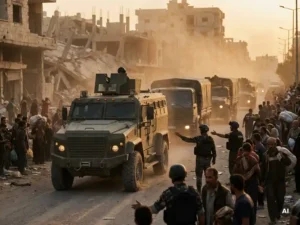
A political evacuation from a hostile country is a structured, time-critical operation that moves personnel out of a deteriorating or dangerous environment before conditions make departure impossible. It is triggered when political instability, civil unrest, armed conflict, or government collapse creates a credible threat to the safety of individuals on the ground. The sections below break down exactly how these operations unfold, who controls them, and what every organisation should know before a crisis arrives.
Who makes the decision to trigger a political evacuation?
The decision to trigger a political evacuation is made jointly by senior leadership and security risk management teams, informed by real-time threat intelligence and guided by pre-agreed crisis thresholds. In most corporate settings, the Chief Security Officer or Global Risk Manager holds primary authority, but the call is rarely made in isolation. It involves legal, HR, and executive leadership, particularly when large numbers of personnel are affected.
Organisations with mature crisis frameworks establish trigger criteria in advance, defining the specific conditions under which an evacuation order is issued. These thresholds might include a government travel advisory reaching a certain level, the breakdown of law enforcement, or the closure of commercial air routes. Having these criteria documented before a crisis removes ambiguity and speeds decision-making when time is short.
External risk management partners play an important role at this stage. They provide the ground-level intelligence that internal teams often cannot access independently, including real-time assessments of border conditions, transport availability, and the pace at which a situation is deteriorating. That operational picture is what turns a general concern into a specific, actionable decision.
What are the stages of a political evacuation operation?
A political evacuation typically moves through four core stages: assessment and activation, personnel accounting and consolidation, movement and transit, and post-evacuation support. Each stage has its own dependencies, and a failure at any point creates downstream risk. Understanding this sequence helps organisations plan more effectively and respond more calmly when conditions deteriorate.
Assessment and activation
The operation begins before anyone moves. The response team assesses the current threat environment, identifies who is in-country, where they are located, and what routes and assets are available. This stage determines whether a full evacuation, a partial withdrawal, or shelter-in-place is the right response. Decisions made here shape everything that follows.
Personnel accounting and consolidation
Once activation is confirmed, the priority is knowing exactly where every person is. Personnel are contacted, accounted for, and directed to a pre-designated assembly point or safe location. This stage is where tracking technology and 24/7 communication channels become critical. Groups are consolidated to make movement more efficient and to reduce the number of separate movements that need to be coordinated simultaneously.
Movement and transit
This is the operational core of a hostile country evacuation. Ground transport, charter aircraft, or a combination of both are deployed based on what routes remain viable. In the Middle East crisis operations NGS has supported, this has included discreet SUV transfers for individuals, coaches for larger groups, and charter aircraft with capacity for up to 200 passengers per flight. Local providers with knowledge of border conditions, road closures, and checkpoint requirements are essential at this stage. When NGS supported evacuations across Kuwait, Iraq, and the UAE during a regional crisis, local teams adjusted routes in real time as conditions changed, completing all movements without transit incidents.
Post-evacuation support
The operation does not end when personnel cross a border. Post-evacuation support covers medical checks, psychological welfare, onward travel arrangements, and communication with families. Organisations also need to begin documenting the operation for duty-of-care records and for improving future response plans.
How long does a political evacuation actually take?
The duration of a political evacuation from a hostile country depends on the size of the group, the complexity of the environment, and how much preparation was in place before the crisis began. A single individual in an urban area with pre-arranged transport can be moved within hours. A large corporate group spread across multiple locations in a country with deteriorating infrastructure may take several days to extract safely.
Response time at the start of the operation is one of the most significant variables. Industry-standard response times for crisis deployment can run from three to seven days. Providers with established local networks and pre-positioned assets can begin deploying within 40 minutes in urban environments, which makes an enormous difference when conditions are moving quickly.
The condition of exit routes also affects duration significantly. When commercial flights are suspended and land borders are under pressure, the operation shifts to charter aviation and alternative ground corridors. These options take longer to arrange without prior relationships with aviation brokers and regional transport providers. Organisations that have these relationships established in advance move faster when it matters most.
What is the difference between a political evacuation and a security evacuation?
A political evacuation is triggered by instability at the governmental or societal level, such as a coup, civil war, or the collapse of public order. A security evacuation is triggered by a specific, targeted threat to a person or group, such as a credible kidnap threat, an armed attack, or a direct security incident. The distinction matters because each type of operation requires a different response profile.
In a political evacuation, the threat is environmental and affects everyone in the region. The focus is on moving large numbers of people efficiently and safely before conditions worsen. Route planning, transport capacity, and border management are the primary operational concerns. During the Arab Spring, NGS supported the movement of nearly 4,000 personnel from Libya, an operation that required coordinating multiple simultaneous ground and air movements across a rapidly changing environment.
In a security evacuation, the threat is specific and the operation is more targeted. Close protection, counter-surveillance, and discreet movement take priority. The group size is typically smaller, and the planning is more tightly focused on the individual threat picture. Some operations involve elements of both, particularly when political instability creates the conditions for opportunistic criminal or hostile activity against specific individuals or organisations.
What should employees do when a political evacuation is ordered?
When a political evacuation is ordered, employees should follow the instructions of their security lead or crisis management team immediately, without deviation. The single most important action is to make contact with the designated point of communication and confirm their location. Employees should not attempt to self-evacuate unless specifically instructed to do so, as uncoordinated movement can create additional risk.
Practically, employees should:
- Respond immediately to any communication from their organisation’s travel risk or security team
- Confirm their exact location and the number of people with them
- Move to the designated assembly point if instructed, taking only essential documents and items
- Avoid sharing location or movement details on public or unsecured channels
- Follow route guidance from the response team rather than making independent judgements about safe routes
- Stay in contact at regular intervals until they have cleared the risk area
Preparation before travel reduces the pressure on employees during an evacuation. Personnel who have received hostile environment awareness training respond more calmly and make better decisions under pressure. They understand the protocols, know what to expect, and are less likely to take actions that complicate the broader operation.
How do companies prepare for political evacuations before a crisis hits?
Effective preparation for a political evacuation begins long before any specific threat emerges. Companies that handle hostile country evacuations well share a common characteristic: they treat crisis preparedness as an ongoing operational function, not a reactive measure. This means building plans, testing them, and maintaining the relationships and intelligence feeds needed to act quickly.
The core elements of pre-crisis preparation include:
- Country risk assessments: Maintaining current, detailed assessments of every country where personnel are deployed, covering political stability, security conditions, medical infrastructure, and exit options
- Pre-agreed evacuation thresholds: Defining in advance the conditions that will trigger a full or partial evacuation, removing the need for real-time debate during a fast-moving crisis
- Personnel tracking: Knowing where every employee is at any given time, including contractors and dependants where relevant
- Established provider relationships: Having vetted transport, aviation, and local support providers already in place, so activation is immediate rather than reactive
- Crisis communication protocols: Clear, tested channels for reaching all personnel and confirming their status quickly
- Regular training and exercises: Tabletop exercises and live drills that test the plan against realistic scenarios
Aligning corporate evacuation planning with ISO 31030 provides a recognised framework for travel risk management that covers the full journey from pre-travel assessment through to post-incident support. This standard helps organisations demonstrate duty of care and build plans that are operationally sound rather than simply documented.
How NGS supports political evacuation planning and response
NGS provides end-to-end support for organisations operating in or near hostile environments, covering both the preparation phase and the live emergency response. For corporate security and risk managers responsible for personnel across complex geographies, NGS offers:
- 24/7 emergency response and crisis coordination through a global operations centre
- Political and security evacuations supported by a network spanning more than 190 countries
- Real-time traveller tracking and threat monitoring through the Aurora platform
- Charter aviation, armoured ground transport, and cross-border movement planning
- Pre-travel country risk assessments and hostile environment training
- Proven operational experience, including the evacuation of nearly 4,000 personnel from Libya and emergency response during the Russia-Ukraine conflict
If your organisation operates in high-risk regions and needs a credible emergency evacuation process in place, contact the NGS team to discuss your requirements.
Related Articles
- How does mass casualty evacuation differ from standard evacuation?
- What is business continuity planning in the context of travel risk?
- How do local fixers help journalists and aid workers in dangerous areas?
- What evacuation options exist when travelling in conflict zones?
- What is the difference between a travel warning and a travel alert?