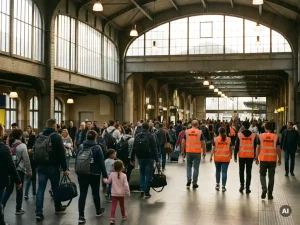
Mass evacuation operations fail most often because the real world refuses to behave like the plan. Even well-prepared organisations encounter failures when scale, speed, and simultaneous crises collide in ways that no tabletop exercise fully anticipates. The core challenges include incomplete personnel tracking, fragmented command structures, transport bottlenecks, and the collapse of real-time communication under pressure. Understanding where these failures occur is the first step toward building evacuation plans that hold when conditions deteriorate.
Why do mass evacuations fail even with prior planning?
Mass evacuations fail because planning assumptions rarely survive contact with a live crisis. Most plans are built around a single scenario, a stable communications environment, and a fixed number of people in known locations. When conditions shift, those foundations give way quickly. The plan becomes a starting point rather than a guide, and organisations without the flexibility to adapt find themselves paralysed at exactly the moment they need to act.
The most common failure points are predictable in hindsight. Personnel rosters are out of date. Designated assembly points become inaccessible. Key decision-makers are unreachable. Local transport providers who agreed to support the operation have already committed their assets elsewhere. Each individual gap is manageable. Combined, they create a coordination breakdown that cascades across the entire operation.
There is also a human dimension that plans often underestimate. Employees respond differently under stress. Some comply immediately. Others hesitate, seek reassurance, or make independent decisions that pull resources in unexpected directions. A family evacuation introduces additional complexity, because family members are not bound by corporate protocols and their needs are not always predictable. Effective evacuation planning must account for behaviour, not just logistics.
How does scale change the complexity of an evacuation?
Scale transforms an evacuation from a coordination problem into a systems problem. Moving ten people from a single location is a logistics task. Moving hundreds of people across multiple countries, with different travel documents, medical needs, and risk profiles, requires a fundamentally different operational structure. Every additional person and location multiplies the number of decisions, dependencies, and potential failure points.
At scale, transport capacity becomes a hard constraint. Ground vehicles, charter aircraft, and border crossing slots are finite. When multiple organisations are competing for the same assets during a regional crisis, availability collapses fast. Organisations that have not pre-negotiated capacity or built provider relationships in advance find themselves at the back of a very long queue.
Command and control also break down at scale if it has not been designed for it. A single operations team cannot effectively track hundreds of individual movements, respond to exceptions, and maintain communication with clients simultaneously without structured systems and clear escalation paths. The organisations that manage large-scale evacuations successfully tend to be those that have separated strategic decision-making from tactical execution, so that each level can function without constant interruption from the other.
What role does real-time intelligence play in evacuation decisions?
Real-time intelligence is the single most important factor in keeping an evacuation moving when conditions change. Without live situational awareness, planners are working from information that may already be hours out of date. In a fast-moving crisis, that gap can mean the difference between a route being open or closed, a border crossing being functional or overwhelmed, and a charter flight departing on schedule or being grounded.
Intelligence in this context is not abstract threat reporting. It is specific, actionable information: which roads are passable, where checkpoints have appeared, what the processing times at border crossings look like, and whether the receiving facility at the destination is ready to accept arrivals. That kind of granular, on-the-ground data can only come from local sources who are embedded in the environment and monitoring it continuously.
During the Middle East crisis documented in NGS operational records, 565 calls were received and 57 live cases managed simultaneously across multiple countries. The ability to keep those cases moving depended entirely on continuous intelligence feeds that allowed the operations team to adjust routes, swap transport modes, and redirect personnel without losing control of the broader picture. Intelligence did not just inform decisions; it made decisions possible in the first place.
How do you coordinate evacuations across multiple locations simultaneously?
Coordinating evacuations across multiple locations simultaneously requires a centralised command structure with decentralised execution. The operations centre holds the overall picture and manages resource allocation, while local teams on the ground handle the specific conditions of each location without needing constant authorisation from the centre. This separation allows speed at the local level and coherence at the strategic level.
Centralised oversight with local autonomy
The operations centre must maintain a live common operating picture that shows where every group is, what transport is assigned, and what the current status of each movement is. Without this, resources get double-assigned, communication gaps open up, and clients receive conflicting information. Technology platforms that integrate tracking, communication, and case management are essential at this level of complexity.
Local teams as the operational backbone
Local providers and teams carry the weight of execution. They understand road conditions, border requirements, and the practical realities that rarely appear in a written plan. When a route changes or a crossing becomes congested, local teams can respond immediately rather than waiting for authorisation from a distant headquarters. During NGS operations in the Middle East, trusted local providers across the region adjusted plans in real time as conditions shifted, scaling transport capacity when demand increased and rerouting movements when original paths became impractical.
Communication between levels must be structured and disciplined. Too much noise at the operations centre level creates confusion. Too little communication from local teams creates blind spots. Effective multi-location coordination depends on agreed reporting intervals, clear escalation triggers, and a shared understanding of who makes which decisions at each level.
What are the biggest logistical obstacles in mass evacuation operations?
The biggest logistical obstacles in mass evacuation operations are transport availability, border crossing management, and the diversity of individual needs within the evacuating group. Each of these is challenging in isolation. When they occur simultaneously, as they typically do in a genuine crisis, they require a level of operational flexibility that most organisations have not built in advance.
Transport availability collapses quickly when a regional crisis affects multiple organisations at once. Ground vehicles, coaches, and charter aircraft are all in demand at the same moment. Organisations without pre-established provider networks face both scarcity and inflated costs. Charter aircraft with capacity for up to 200 passengers per flight can resolve large group movements, but securing that capacity requires relationships and planning that cannot be built during the crisis itself.
Border crossings introduce a different category of challenge. Processing times, documentation requirements, and the behaviour of border officials under pressure are all variables that cannot be fully controlled. Local knowledge is essential here. Drivers and ground teams who understand the specific requirements of each crossing, and who have existing relationships with local officials, can navigate these chokepoints far more effectively than external teams arriving without context.
The diversity of evacuee needs is often underestimated. A group of several hundred people will include individuals with medical requirements, family units with children, personnel holding different nationalities with different visa requirements, and individuals at different levels of risk. A single transport solution does not serve all of them. Matching each person or group to the right movement type requires assessment, flexibility, and the capacity to run multiple parallel streams without losing track of any of them.
When should a company activate its mass evacuation plan?
A company should activate its mass evacuation plan before the situation becomes critical, not after. The most common mistake organisations make is waiting for certainty before acting. By the time a crisis is unambiguous, transport options have narrowed, routes have deteriorated, and the window for an orderly evacuation has often already closed. Pre-defined trigger points, agreed in advance, remove the hesitation that costs time when time is the scarcest resource.
Trigger points should be tied to observable indicators rather than subjective assessments. A government travel advisory reaching a specific level, a credible threat against personnel, civil unrest reaching a defined threshold, or the closure of key infrastructure are all concrete signals that can be monitored and acted upon without requiring a committee decision in the moment. Organisations that define these triggers in advance can move faster and with more confidence when they are reached.
There is also a duty of care dimension to this decision. Corporate security and risk managers carry a legal and ethical obligation to protect employees. Delaying evacuation to avoid disruption or cost creates liability exposure that far exceeds the cost of acting early. An evacuation that turns out to have been unnecessary is recoverable. An evacuation that was delayed too long is not. The standard for activation should always favour the safety of personnel over operational convenience.
How NGS supports mass evacuation operations
NGS delivers end-to-end emergency response and evacuation capability for corporate clients facing exactly the challenges described above. Whether a situation involves individual travellers or hundreds of personnel across multiple countries, NGS provides the structure, assets, and intelligence needed to keep people moving safely.
- 24/7 operations centre with live situational awareness and real-time case management across simultaneous incidents
- Global provider network spanning 190+ countries with pre-vetted local teams who understand on-the-ground conditions
- Flexible transport solutions including discreet vehicle transfers, coordinated ground convoys, and charter aircraft with capacity for up to 200 passengers
- Medical and security evacuation integrated into a single operational response, covering personnel with clinical needs alongside standard group movements
- Pre-crisis planning support including trigger-point frameworks, personnel tracking, and evacuation rehearsals aligned with ISO 31030
If your organisation operates in environments where mass evacuation risks are real, the time to build that capability is before you need it. Contact NGS to discuss how a tailored emergency response plan can protect your people when conditions deteriorate.
Related Articles
- What is the difference between a travel warning and a travel ban?
- How do you vet a local security provider in a high-risk destination?
- What is the role of a travel risk manager in a large organisation?
- What vaccinations do you need before travelling to high-risk countries?
- What is the difference between a travel warning and a travel alert?