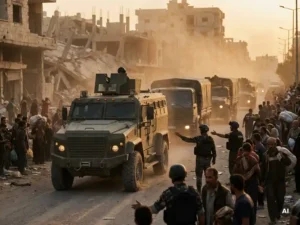
To evacuate employees from a conflict zone safely, organisations need a pre-built emergency evacuation plan, verified on-the-ground support, live threat intelligence, and a clear chain of command activated before the situation becomes critical. Safe evacuation is not improvised; it depends on decisions made well in advance of a crisis. The sections below address the most important questions organisations face when planning and executing a conflict zone evacuation.
What are the biggest risks when evacuating employees from a conflict zone?
The biggest risks in a conflict zone evacuation are route insecurity, communication breakdown, incomplete personnel tracking, and delayed decision-making. Each of these can turn a manageable situation into a life-threatening one. Understanding where evacuations fail is the starting point for building a plan that holds under pressure.
Route insecurity is often the most immediate threat. Roads that were passable in the morning can be blocked, contested, or dangerous by the afternoon. Without live intelligence feeding into route decisions, convoys can move into harm’s way. This is why static evacuation plans, built once and never updated, carry significant risk in volatile environments.
Personnel tracking is another critical vulnerability. Organisations frequently discover during a crisis that they do not have accurate, real-time information on where their people are. Without this, it is impossible to prioritise movements, account for individuals, or confirm safe arrivals. Duty of care obligations require organisations to know where their employees are at all times, particularly in high-risk regions.
Communication breakdown compounds every other risk. When employees cannot reach their organisation, and the organisation cannot reach its response team, decisions slow down. In a conflict zone, delay carries a cost that cannot be recovered. Establishing redundant communication channels, including satellite options, before a crisis begins is not optional. It is foundational.
How do you assess whether a conflict zone evacuation is necessary?
An evacuation decision should be based on a structured threat assessment that weighs security conditions, access to safe routes, the operational viability of remaining in place, and the level of risk to personnel relative to the organisation’s duty of care obligations. The decision is rarely binary; it usually involves a spectrum of options from shelter-in-place to full evacuation.
Organisations should assess several factors in parallel:
- Security environment: Has the threat level escalated beyond what protective measures can reasonably mitigate?
- Route availability: Are exit routes still accessible, and for how long?
- Government guidance: Have host-country authorities or home-government advisories changed?
- Local intelligence: What are trusted local contacts and providers reporting on the ground?
- Personnel vulnerability: Are there individuals with medical needs, family members, or other factors that require earlier movement?
Waiting for absolute certainty before making the call is one of the most common and costly mistakes organisations make. By the time the situation is unambiguously dangerous, the window for a controlled evacuation may have already closed. Pre-agreed trigger points, specific conditions that automatically initiate evacuation procedures, remove the delay caused by trying to reach consensus during a crisis.
What does a conflict zone evacuation plan include?
A conflict zone evacuation plan includes personnel accountability systems, primary and contingency exit routes, transport arrangements across multiple modes, communication protocols, medical support provisions, designated assembly points, and clearly defined decision-making authority. A plan that addresses only one or two of these elements will not hold when conditions deteriorate.
Personnel accountability and movement logistics
Before any movement begins, the organisation must know who needs to evacuate, where they are, and what their individual requirements are. This includes employees, dependants, contractors, and any third parties towards whom the organisation has a duty of care obligation. Movement plans should be segmented by group: individual travellers, families, and larger corporate groups require different transport and coordination approaches.
Transport options should be matched to the situation. Discreet SUV transfers suit small groups or high-profile individuals. Coaches and coordinated road convoys work for larger groups. Charter aircraft become necessary when ground routes are compromised or time is critical, with capacity configurations varying depending on the number of passengers and whether medical support is required in transit.
Communication and contingency protocols
The plan must define how information flows during an evacuation: who communicates with employees, who liaises with the response team, and how decisions are escalated. Contingency routes and alternative assembly points should be documented in advance, because primary options may become unavailable without warning. Plans should be reviewed and updated regularly, not filed and forgotten.
Who is responsible for coordinating a corporate evacuation?
Responsibility for coordinating a corporate conflict zone evacuation sits with the organisation’s security or risk management function, typically led by the Chief Security Officer, Head of Corporate Security, or Global Risk Manager. In practice, effective coordination requires a specialist external response partner with on-the-ground capability, because internal teams rarely have the local assets, provider networks, or 24/7 operational capacity to execute a complex evacuation independently.
The internal team’s role is strategic: making decisions, communicating with leadership, and maintaining oversight. The external partner’s role is operational: activating local providers, managing transport, monitoring routes, and tracking personnel in real time. These two functions must be aligned before a crisis begins, not introduced to each other during one.
Clear decision-making authority is essential. During an evacuation, there is no time to seek approvals through multiple layers of management. Pre-agreed authority levels, defining who can authorise which types of movement and expenditure, allow the response to move at the speed the situation demands. Organisations that have not defined this in advance consistently experience delays that put people at greater risk.
How does medical support factor into conflict zone evacuations?
Medical support is a critical component of any conflict zone evacuation. Employees may be injured, ill, or have pre-existing conditions that affect how and when they can travel. Without medical assessment integrated into the evacuation plan, organisations risk moving people who are not fit to travel or failing to provide appropriate care during transit.
Medical considerations affect evacuation planning at several levels. Pre-departure assessment determines travel tolerance, whether individuals can travel seated, require stretcher support, or need a medical escort. This assessment directly shapes transport configuration. As demonstrated in multi-patient medical evacuation operations, matching aircraft configuration to clinical need rather than defaulting to individual aircraft per patient can preserve both safety and resources significantly.
In-transit medical support matters equally. For evacuations covering long distances or complex routes, having qualified medical personnel embedded in the movement team reduces risk and ensures that deteriorating conditions can be managed before they become emergencies. Organisations should also confirm that receiving facilities at the destination are prepared and capable of providing the level of care required; landing into uncertainty delays treatment and increases risk.
What should organisations do after an evacuation is complete?
After a conflict zone evacuation, organisations should conduct a full personnel accountability check, provide psychological and practical support to evacuees, document the operation in detail, and review the plan to incorporate lessons learned. The evacuation is not complete when the last person crosses the border; it is complete when everyone is accounted for, supported, and the organisation understands what worked and what did not.
Immediate post-evacuation priorities include:
- Full headcount confirmation: Verify that every individual on the evacuation list has reached a safe location. Do not assume arrival until it is confirmed.
- Welfare support: Evacuees, particularly those who have moved families or experienced a sudden departure, will need access to psychological support, practical assistance, and clear communication about what happens next.
- Operational debrief: Gather information from everyone involved in the response, including local providers and the response team. Identify where the plan held and where it was stressed.
- Plan revision: Update the evacuation plan based on what the operation revealed. Gaps that became visible under pressure must be addressed before the next crisis.
- Duty of care review: Assess whether the organisation’s duty of care obligations were met throughout the process, and identify any areas where policy or procedure needs strengthening.
Organisations that treat the post-evacuation phase as an operational afterthought miss the most important opportunity to improve. The lessons from a real evacuation are more valuable than any tabletop exercise, and they should be captured while the detail is still fresh.
How NGS supports conflict zone evacuations
Northcott Global Solutions provides end-to-end support for organisations facing the challenge of evacuating employees from conflict zones and high-risk environments. NGS brings together the people, technology, and local networks that make a controlled evacuation possible, even when conditions are changing rapidly.
- 24/7 emergency response: A global operations centre that monitors threats in real time and activates response immediately, with an average urban response time of 40 minutes or less
- On-the-ground local capability: A network spanning 190+ countries and 50,000+ vetted providers, enabling ground convoys, cross-border transfers, and charter aviation to be activated quickly
- Live personnel tracking: The Aurora Platform provides real-time visibility of traveller locations, route conditions, and operational status throughout an evacuation
- Medical integration: Clinical assessment and medical support built into evacuation planning, covering travel tolerance, in-transit care, and receiving facility coordination
- Proven track record: Documented operations include the evacuation of nearly 4,000 personnel during the Arab Spring, emergency evacuations during the Russia-Ukraine conflict, and regional crisis evacuations supporting hundreds of individuals and families across multiple countries simultaneously
If your organisation operates in or near high-risk regions and needs a credible conflict zone evacuation capability, speak with the NGS team to discuss your requirements and how a tailored response plan can be built around your operations.