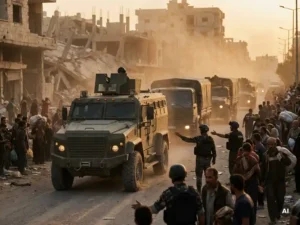
A medical evacuation moves a person to a higher level of clinical care because their health condition requires treatment that is unavailable locally. A security evacuation moves people out of a location because the environment itself has become dangerous, through conflict, civil unrest, or a direct threat to personnel. The trigger is different, the decision-making is different, and the assets deployed are different.
Both types of evacuation fall under an organisation’s duty of care obligations, and both can emerge without warning. Understanding the distinction helps corporate risk managers plan appropriately, rather than discovering the gaps when a crisis is already unfolding.
When does a situation require security evacuation rather than medical?
A security evacuation is required when the primary threat is environmental or situational rather than physical injury or illness. If a person’s life or safety is at risk because of where they are, not because of their medical condition, a security evacuation is the appropriate response. The driving factor is the threat to the location, not the health of the individual.
Common triggers for a security evacuation include:
- Armed conflict or military escalation in or near a city
- Civil unrest, rioting, or breakdown of public order
- Coup attempts or sudden changes in political control
- Credible and targeted threats against specific personnel
- Kidnap risk or deteriorating law enforcement capacity
- Natural disasters that create ongoing danger rather than immediate medical need
The distinction matters operationally. In a security evacuation, the goal is to move people away from danger to a safe location, which may be a neighbouring country, a secure facility, or a designated assembly point. Medical condition is a secondary consideration unless someone is already injured or unwell. During the Arab Spring, for example, NGS extracted nearly 4,000 personnel from Libya and supported movement operations in Egypt: these were security evacuations driven by political collapse, not medical emergencies.
A useful test for risk managers: if the person is healthy but the environment is not, the response is a security evacuation. If the environment is stable but the person’s health is deteriorating, the response is a medical evacuation.
What are the key operational differences between the two?
The key operational differences between a medical evacuation and a security evacuation lie in the assets used, the clinical requirements, the routing logic, and the decision criteria. A medical evacuation is driven by clinical need and requires medically equipped transport, qualified personnel, and a receiving facility capable of providing the required care. A security evacuation is driven by threat assessment and requires speed, route intelligence, scalable transport, and access to local networks.
Medical evacuation: clinical structure
A medevac begins with a medical assessment. Before any movement occurs, the patient’s condition must be evaluated to determine travel tolerance, whether they can sit upright, whether they require stretcher support, whether they need continuous monitoring in flight. Aircraft selection, crew composition, and receiving facility arrangements all follow from that clinical picture. Moving a patient before they are fit to travel can worsen outcomes, so timing is determined by medicine, not urgency alone.
A well-structured medical evacuation also includes coordination with the receiving hospital before departure. This removes uncertainty on arrival and ensures that the care pathway continues without interruption. In a documented NGS case involving six travellers evacuated from Sudan, an early medical review allowed the team to consolidate six separate air ambulances into two, delivering significant cost savings without reducing clinical safety for any patient.
Security evacuation: speed and scale
A security evacuation prioritises movement volume, route flexibility, and speed of deployment. The assets are broader: armoured vehicles, coaches, charter aircraft with capacity for up to 200 passengers, and cross-border ground convoys. Local knowledge is critical. Trusted on-the-ground teams understand border conditions, road closures, and access restrictions that no remote plan can fully anticipate.
Communication during a security evacuation is also structured differently. Clients need live updates on where personnel are, what routes are still viable, and what decisions need to be made next. During a Middle East crisis evacuation, NGS coordinated movements across Kuwait, Iraq, and the UAE simultaneously, supporting both individual travellers and large family groups while adjusting routes as conditions changed.
Can a medical and security evacuation happen at the same time?
Yes. A medical and security evacuation can and do occur simultaneously, and this is one of the most operationally demanding scenarios a risk team can face. When a security crisis produces casualties, or when personnel with existing medical needs are caught in a deteriorating environment, both evacuation types must run in parallel. The challenge is that each requires different assets, different decision chains, and different receiving arrangements.
In practice, this means the operations team must triage effectively. Personnel who are medically stable are moved through the security evacuation stream using ground or charter transport. Those with active medical needs require clinical assessment before movement, appropriate medical escort, and a confirmed receiving facility at the destination. Merging these two streams without a clear command structure creates dangerous confusion.
Organisations operating in high-risk environments should build dual-track protocols into their crisis response plans before an incident occurs. This includes pre-identifying which personnel have medical vulnerabilities, establishing relationships with medical providers in key locations, and ensuring the security evacuation plan does not assume all evacuees are fit to travel. The two streams must be designed to work alongside each other, not as alternatives.
Who authorises and coordinates each type of evacuation?
The authorisation and coordination of an evacuation depends on the type of incident, the client’s internal governance structure, and the external providers engaged. In most corporate settings, a security evacuation is authorised by a senior security or risk executive, typically a Chief Security Officer or Global Risk Manager, often in consultation with regional leadership and legal or HR. A medical evacuation may involve the same decision-makers, but clinical sign-off from a medical team is also required before movement.
Externally, a specialist provider coordinates the operational execution. This includes activating transport assets, liaising with local teams, managing communications with receiving facilities, and keeping the client informed throughout. The distinction between authorisation (an internal corporate decision) and coordination (an operational function handled by the response provider) is important. Organisations that conflate the two often experience delays because internal approvals are sought for decisions that should already be delegated to the response team.
For medical evacuations, the coordination chain typically includes a medical director or senior clinician who determines travel readiness, a logistics team that arranges the aircraft and crew, and a case manager who maintains contact with the client and receiving hospital. For security evacuations, the coordination chain centres on an operations commander who manages routes, assets, and real-time intelligence. In both cases, 24/7 availability is not optional: crises do not follow business hours.
What should corporate risk plans include for both evacuation types?
A corporate risk plan should include clearly defined triggers, pre-authorised response protocols, and confirmed provider relationships for both medical and security evacuations before any incident occurs. Plans that are built reactively, after an incident begins, consistently produce slower responses, higher costs, and greater risk to personnel.
For medical evacuation planning, the plan should include:
- A register of personnel with pre-existing medical conditions or elevated health risk
- Confirmed relationships with medical assistance providers covering key operating regions
- Pre-agreed guarantee of payment processes to avoid treatment delays
- Defined criteria for what constitutes a medical evacuation versus local treatment
- Identified receiving facilities in likely destination countries
For security evacuation planning, the plan should include:
- Country-specific threat thresholds that trigger escalation to evacuation
- Assembly points and primary and secondary evacuation routes for each operating location
- A traveller tracking system that provides real-time visibility of personnel locations
- Pre-contracted transport capacity, including ground and aviation options
- A communication tree that defines who is notified, in what order, and through what channels
Plans should also address the overlap scenario: what happens when both evacuation types are required simultaneously. This means designating a single operations lead who can manage both streams, and ensuring that the medical and security providers are already familiar with each other’s protocols. Alignment with travel risk management frameworks such as ISO 31030 provides a recognised structure for building these plans and demonstrating duty of care compliance to regulators, insurers, and stakeholders.
Testing the plan matters as much as writing it. Tabletop exercises that simulate dual-track evacuation scenarios expose gaps that are invisible on paper and give decision-makers the confidence to act quickly when a real incident develops.
How NGS supports medical and security evacuations
Northcott Global Solutions delivers both medical and security evacuation capability through a single, integrated emergency response function, available 24/7 and designed to handle multiple simultaneous operations across different geographies.
- Medical evacuation: Clinical assessment, guarantee of payment coordination, air ambulance deployment, medical escort, and receiving facility arrangement
- Security evacuation: Threat-driven movement planning, ground and charter transport, local provider activation, and real-time traveller tracking
- Dual-track response: A command structure capable of running both evacuation types in parallel without operational confusion
- Pre-incident planning: Country risk assessments, crisis response plan development, and evacuation protocol design aligned to ISO 31030
- Technology integration: The Aurora platform provides live country intelligence, traveller visibility, and case management in a single system
If your organisation operates in environments where either type of evacuation could become necessary, the time to establish your response capability is before an incident occurs. Contact the NGS team to discuss your evacuation planning requirements and how a tailored response framework can be built around your operations.
Related Articles
- What is a medical evacuation and when do you need one?
- Why do governments rely on private companies for emergency evacuations?
- What is a travel security briefing and when should you use one?
- What should a corporate travel risk policy include?
- What vaccinations do you need before travelling to high-risk countries?