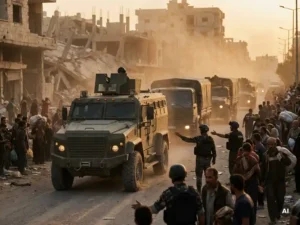
Yes, emergency medical evacuation from a conflict zone is possible, but it requires specialist coordination that goes far beyond standard medical transport. The combination of active hostilities, restricted airspace, damaged infrastructure, and limited ground access means that only providers with genuine operational experience in high-risk environments can execute it reliably. The questions below unpack how it works, what makes it different, and what organisations need to have in place before a crisis occurs.
How does medical evacuation from a conflict zone actually work?
Medical evacuation from a conflict zone works by combining clinical assessment, security coordination, aviation logistics, and real-time intelligence into a single, managed operation. Unlike a standard medevac, the medical component is only one part of the challenge. The team must first establish whether movement is physically possible given the security environment, then build a route that accounts for active threats, border conditions, and available assets.
The process typically begins with a rapid assessment of the patient’s condition and travel tolerance. This determines whether the individual can be moved immediately or needs stabilisation in place before any transfer occurs. Acting too early can create risk; waiting too long can close off viable exit routes. Once clinical readiness is confirmed, the team identifies the safest corridor out of the affected area, whether by ground, air, or a combination of both.
Aviation arrangements in conflict zones often involve charter aircraft rather than commercial carriers, since commercial routes are frequently suspended or restricted. Receiving facilities must be confirmed in advance so that the patient arrives in a prepared environment rather than an uncertain one. Throughout the operation, a 24/7 operations centre maintains visibility over every stage, adjusting plans as conditions change on the ground.
What makes conflict zone evacuation different from standard medevac?
Conflict zone evacuation differs from standard medical evacuation because the security environment creates operational constraints that do not exist in stable settings. In a conventional medevac, the primary challenge is clinical and logistical. In a conflict zone, every decision must account for active threats, restricted access, and rapidly changing conditions that can make a planned route impassable within hours.
Several factors set conflict zone operations apart:
- Airspace restrictions: Military operations frequently close or limit civilian airspace, requiring special permissions or alternative routing that can add significant time and complexity.
- Ground security: Road movements through conflict areas require armoured transport, vetted local drivers, and live route intelligence. A route that was safe in the morning may not be safe by afternoon.
- Border crossings: Cross-border evacuations involve documentation, permissions, and liaison with multiple authorities simultaneously, each with its own requirements and timelines.
- Communication gaps: Infrastructure damage can disrupt standard communication channels, making satellite communication and redundant contact protocols essential.
- Clinical constraints: Medical facilities inside conflict zones are often overwhelmed or damaged, meaning the patient may need to be stabilised in austere conditions before any transfer can begin.
The result is an operation that demands security expertise alongside medical capability. A provider who handles routine medevac but lacks experience in high-risk environment operations will encounter obstacles that they are not equipped to resolve under pressure.
Who can legally and operationally carry out a conflict zone evacuation?
Conflict zone evacuations can be carried out by specialist risk management and emergency response companies that hold the necessary operational permissions, provider networks, and in-country relationships to move people through active or post-conflict environments. There is no single universal licence required, but the operational reality means that only a small number of providers have the genuine capability to execute these missions safely.
From a legal standpoint, the key requirements typically include aviation permissions for the specific airspace involved, compliance with the regulations of each country the operation passes through, and appropriate duty of care documentation linking the provider to the individual being evacuated. In some cases, coordination with national governments or military authorities is necessary to gain access to restricted areas or crossing points.
Operationally, the provider must have vetted local assets already in place. Attempting to build a network from scratch during an active crisis is not viable. Organisations with a pre-established footprint across high-risk countries, including trusted ground teams, local medical contacts, and aviation partners, are the only ones capable of responding within the timeframes that conflict zone situations demand. The ability to manage multiple simultaneous operations is also important, since crises rarely affect only one person or one location at a time.
What are the biggest obstacles to evacuating someone from a war zone?
The biggest obstacles to evacuating someone from a war zone are restricted access, unpredictable security conditions, aviation limitations, and the need to coordinate multiple moving parts simultaneously under time pressure. Each of these can delay or derail an operation if the provider does not have the experience and infrastructure to manage them in real time.
Access and route availability
Ground routes in conflict zones can become impassable with little warning due to military activity, checkpoints, or infrastructure damage. This means that evacuation teams must plan primary and contingency routes simultaneously and be prepared to switch between them as conditions evolve. Local knowledge is critical here. Teams who understand the specific terrain, the behaviour of local authorities, and the practical realities of movement in that environment make faster and safer decisions than those relying on remote planning alone.
Aviation and airspace constraints
Commercial aviation typically suspends operations over active conflict areas. Arranging charter aircraft requires permissions that can take time to obtain, and landing zones may be limited or insecure. In some cases, helicopter transfers are the only viable option for the first stage of an evacuation, with fixed-wing aircraft used once the patient reaches a safer area. Each transition point adds coordination complexity and must be managed without gaps in oversight.
Clinical and logistical timing
Moving a patient before they are medically stable increases risk. Waiting too long can close off exit routes as a situation deteriorates. Balancing clinical readiness against the operational window is one of the most difficult judgements in conflict zone evacuation, and it requires medical professionals who understand both the patient’s condition and the operational constraints they are working within.
Should your duty of care plan include conflict zone evacuation cover?
Yes, if your organisation sends employees to high-risk countries or regions with elevated instability, your duty of care plan should explicitly include conflict zone evacuation cover. Organisations have a legal and moral obligation to protect travelling employees, and that obligation does not pause because a destination becomes dangerous. In practice, it becomes more pressing precisely when conditions deteriorate.
Travel risk management aligned with ISO 31030 requires organisations to assess risk before travel, monitor conditions during travel, and have response capabilities ready for emergencies. Conflict zone evacuation is one of the most complex emergency scenarios, and relying on improvised arrangements when a crisis occurs is not an adequate response to that standard.
For organisations operating in sectors such as energy, media, humanitarian work, or government contracting, the likelihood of employees being present in or near conflict-affected areas is significant. Even companies that do not intentionally send staff to war zones need to account for the possibility that a stable destination can deteriorate rapidly, as has been demonstrated repeatedly in recent years across multiple regions. Having evacuation cover in place before it is needed is the only way to ensure it is actually available when it matters.
How quickly can an emergency evacuation be arranged in a conflict area?
Response times for emergency evacuations in conflict areas depend heavily on the provider’s existing footprint and pre-positioned assets in the region. Providers with established local networks and 24/7 operations centres can begin mobilising within minutes of receiving a call, though the time to complete an evacuation will vary based on the specific location, security conditions, and the patient’s medical status.
The industry-standard response time for emergency assistance is typically measured in days. Providers who rely on building their response network after a call is received, sourcing aviation, identifying local contacts, and arranging logistics from a standing start, will inevitably take longer to get people moving. In a conflict zone, that delay carries real consequences. Routes close. Conditions change. Windows of opportunity are short.
Speed in these operations comes from preparation, not reaction. Providers with pre-contracted aviation partners, vetted ground teams already operating in the region, and real-time intelligence feeds can compress the time between initial contact and active mobilisation significantly. For organisations evaluating providers, the right question is not simply how fast they claim to respond, but what they have already in place in the specific region where their people are working.
How NGS supports emergency evacuation from high-risk environments
NGS provides end-to-end emergency evacuation support for organisations operating in conflict zones and other high-risk environments. With a proven track record that includes the evacuation of nearly 4,000 personnel from Libya and being the only provider on the ground offering emergency evacuation when Russia invaded Ukraine, NGS brings genuine operational depth to the most complex scenarios.
Key capabilities that support conflict zone and high-risk country evacuation include:
- 24/7 operations centre providing continuous monitoring, real-time decision-making, and client communication throughout an active operation
- Global provider network spanning 190+ countries with pre-vetted local assets, aviation partners, and medical contacts already in place
- Integrated aviation services including charter aircraft, air ambulance coordination, and airspace navigation for restricted environments
- Live traveller tracking through the Aurora platform, ensuring visibility over personnel location and status at all times
- ISO 31030-aligned travel risk management, supporting organisations before, during, and after travel to high-risk destinations
- Multi-patient and large-group capability, with the operational breadth to manage simultaneous evacuations across multiple locations
If your organisation operates in or near conflict-affected regions and needs to review its high-risk country travel response capability, speak to the NGS team. Contact NGS to discuss how your duty of care plan can be built around genuine operational readiness.
Related Articles
- What happens during a political evacuation from a hostile country?
- Can you evacuate staff from a country with no open airports?
- How do you assess travel risk before visiting a dangerous country?
- What role does intelligence play in a successful evacuation?
- What vaccinations do you need before travelling to high-risk countries?