
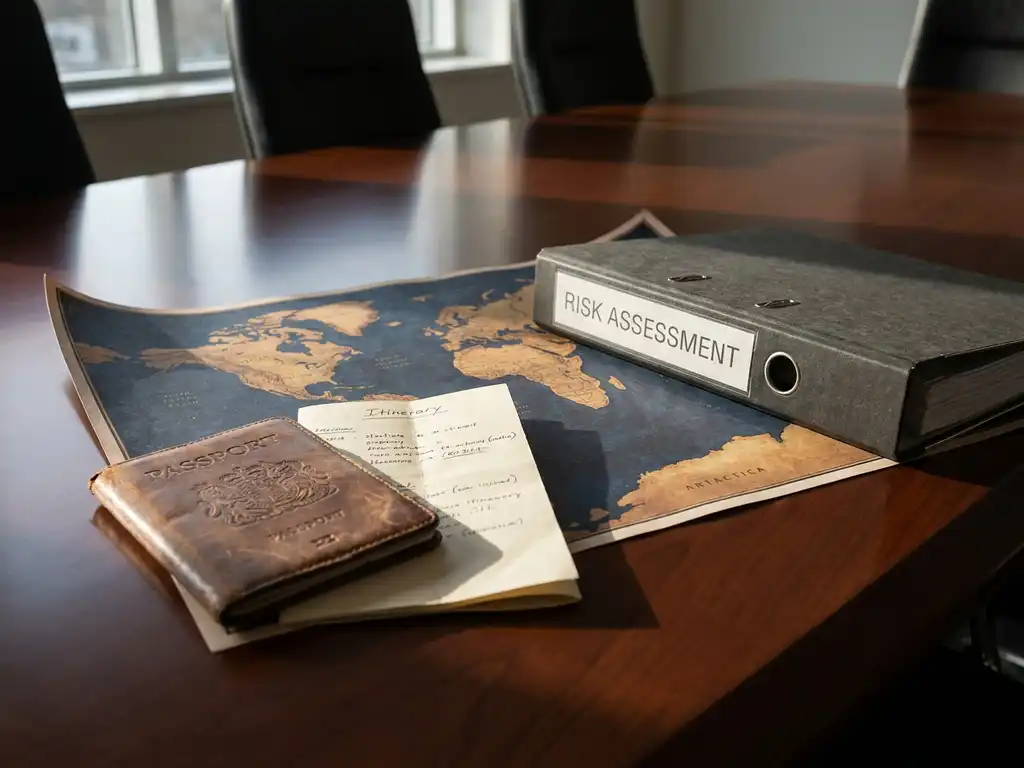
ISO 31030 applies to corporate travel programs by providing a structured framework that helps organisations identify, assess, and manage the risks their employees face when travelling for work. It sets out guidance on establishing a travel risk management system, from pre-travel planning and risk assessment through to incident response and post-travel review. The standard applies to any organisation that sends employees abroad, regardless of size or sector, and covers both routine and high-risk travel. The sections below address the most common questions organisations raise when aligning their travel programs with this standard.
What specific obligations does ISO 31030 place on employers?
ISO 31030 places a set of clear, structured obligations on employers to proactively manage the safety and wellbeing of employees who travel for work. These obligations span the full travel lifecycle, from pre-departure planning to post-travel debriefing, and require organisations to move beyond reactive policies toward a documented, systematic approach to travel risk.
The standard does not carry the force of law, but it establishes a recognised benchmark that regulators, insurers, and courts increasingly treat as evidence of reasonable care. Employers who align with ISO 31030 demonstrate that they have taken deliberate, measurable steps to protect their people.
Core employer obligations under ISO 31030 include:
- Establishing a formal travel risk management policy that is reviewed and updated regularly
- Conducting destination-specific risk assessments before travel is approved
- Providing travellers with pre-trip briefings and relevant health, security, and logistical guidance
- Maintaining real-time visibility of employee locations during travel
- Putting documented emergency response and evacuation procedures in place
- Ensuring employees have access to 24/7 assistance and support while abroad
- Conducting post-travel reviews to capture lessons and improve future programs
The standard also requires that these obligations are proportionate to the level of risk involved. A business trip to a low-risk destination carries different requirements than deployment to a region affected by political instability or conflict.
How does ISO 31030 define travel risk assessment?
ISO 31030 defines travel risk assessment as a systematic process for identifying, analysing, and evaluating the risks associated with a specific journey, destination, or traveller profile. It is not a one-size-fits-all checklist but a dynamic evaluation that accounts for the destination environment, the nature of the work, the individual traveller, and the timing of the trip.
The standard breaks risk assessment into several interconnected components. Destination risk covers political stability, crime levels, health infrastructure, natural hazard exposure, and conflict. Traveller risk accounts for individual factors such as health conditions, nationality, gender, and prior travel experience. Journey risk examines transport modes, routes, and timing. Organisational risk looks at how the company’s operations and profile might attract specific threats.
Critically, ISO 31030 treats risk assessment as an ongoing process rather than a one-time exercise. Conditions change. A destination rated as medium risk at the point of booking can escalate significantly by the time travel occurs. The standard therefore requires organisations to monitor risk continuously and update their assessments as new information becomes available. This is where real-time intelligence tools and travel risk management platforms become operationally essential rather than optional.
Which corporate travel programs must comply with ISO 31030?
ISO 31030 is a guidance standard, not a mandatory regulation, so no corporate travel program is legally required to certify against it. However, any organisation that sends employees abroad has a duty of care under applicable employment, health and safety, and corporate governance law. ISO 31030 provides the most widely recognised framework for demonstrating that this duty is being met in practice.
In practical terms, ISO 31030 is most directly relevant to:
- Multinational corporations with frequent international travel programs
- Organisations deploying staff to medium-, high-, or extreme-risk destinations
- Companies operating in sectors with elevated exposure, such as energy, media, humanitarian work, and professional services
- Organisations whose employees travel to regions affected by conflict, political instability, or significant health risks
- Any employer whose insurance or contractual obligations require demonstrable travel risk governance
Even organisations with low-risk travel profiles benefit from applying the ISO 31030 framework. The standard helps establish baseline processes that scale as travel programs grow or as destinations become more complex. Regulators and courts in multiple jurisdictions have begun referencing internationally recognised standards when assessing whether an employer exercised reasonable care following a travel-related incident.
How does ISO 31030 differ from a general duty of care policy?
A general duty of care policy is a broad statement of an organisation’s commitment to employee safety. ISO 31030 is a structured, operational framework that specifies how that commitment should be implemented, documented, and maintained across every stage of the travel lifecycle. The key difference is specificity: duty of care is the legal and moral principle; ISO 31030 is the methodology for meeting it.
Many organisations have duty of care policies that acknowledge their responsibility to travelling employees but stop short of defining how risks are assessed, how travellers are monitored, or how incidents are managed. ISO 31030 closes that gap by requiring organisations to build systems and processes, not just write policies.
Where a standard duty of care policy might state that “the organisation will take steps to protect employees while travelling,” ISO 31030 requires the organisation to define what those steps are, who is responsible for each one, how they are triggered, and how outcomes are reviewed. This distinction matters significantly when an incident occurs and an organisation must demonstrate that its response was proportionate, timely, and systematic.
ISO 31030 also introduces the concept of proportionality more rigorously than most internal policies do. It requires that the level of risk management applied is calibrated to the actual risk level of each trip, destination, and traveller, rather than applying a uniform approach regardless of exposure.
What does an ISO 31030-aligned travel risk management program look like?
An ISO 31030-aligned travel risk management program is a documented, end-to-end system that governs how an organisation prepares travellers before departure, supports them during travel, and reviews performance afterward. It integrates policy, process, technology, and human response capability into a single coherent framework.
Before travel
Pre-travel processes include destination risk assessments calibrated to low-, medium-, and high-risk classifications, traveller briefings covering security, health, and logistical considerations, and a formal travel approval process that escalates higher-risk trips to senior decision-makers. Travellers should understand the specific threats relevant to their destination and have access to emergency contact protocols before they depart.
During travel
Real-time traveller tracking, 24/7 itinerary monitoring, and access to a live operations centre are the operational backbone of ISO 31030 compliance during travel. The standard requires that organisations can locate their people, communicate with them rapidly, and mobilise a response when something goes wrong. Mass communication tools, check-in protocols, and escalation procedures all form part of this layer.
After travel
Post-travel review processes capture what worked, what did not, and how the risk picture for a destination has changed. This feeds back into updated risk assessments and policy improvements, ensuring the program evolves rather than remaining static.
How can organisations measure their ISO 31030 compliance gaps?
Organisations can measure their ISO 31030 compliance gaps by conducting a structured gap analysis that benchmarks their current travel risk management practices against the standard’s key requirements. This process identifies where documented policies, operational procedures, or technology capabilities fall short of what ISO 31030 specifies.
A practical gap analysis typically covers the following areas:
- Policy and governance: Does a formal travel risk management policy exist, and is it reviewed regularly?
- Risk assessment processes: Are destination assessments conducted before every trip, and are they updated when conditions change?
- Pre-travel communication: Do travellers receive destination-specific briefings before departure?
- Tracking and monitoring: Can the organisation locate its travellers in real time and communicate with them at any hour?
- Emergency response: Are documented evacuation and crisis response procedures in place and tested?
- Post-travel review: Is there a process for capturing lessons and feeding them back into the program?
- Proportionality: Are risk management measures scaled to the actual risk level of each trip?
Organisations that identify gaps in multiple areas should prioritise the areas most directly linked to traveller safety and legal exposure first. Gaps in real-time tracking, emergency response capability, and documented risk assessment carry the greatest consequences if an incident occurs without those systems in place. Engaging an external specialist to conduct the gap analysis adds objectivity and ensures the assessment reflects current best practice, not just internal assumptions.
How NGS helps organisations align with ISO 31030
Northcott Global Solutions delivers a Security and Travel Risk Management service designed specifically to support organisations in meeting the requirements of the ISO 31030 framework. NGS holds ISO 31030 accreditation itself, meaning the standard is embedded in how the company operates, not just what it advises. The service covers every stage of the travel lifecycle:
- Pre-travel risk assessments calibrated to destination risk levels, from low-risk business travel to complex, high-threat environments
- Live traveller tracking and itinerary monitoring via the Aurora platform, providing real-time visibility of personnel locations
- 24/7 operations centre support, with an average urban response time of 40 minutes or less
- Mass emergency communication through the SIREN system, enabling rapid contact with all travellers simultaneously
- Professional travel risk policy writing and on-site consultancy to close documented compliance gaps
- Emergency evacuation capability, including medical and security evacuations, backed by a 190-country operational footprint
Whether your organisation is building an ISO 31030-aligned program from the ground up or identifying gaps in an existing framework, NGS provides the operational depth and documented expertise to support the process. Learn more about NGS and how the team can help your organisation meet its duty of care obligations.
Related Articles
- What is the difference between travel risk and travel safety?
- How do you measure the effectiveness of a travel risk program?
- How do you integrate travel risk management into HR and procurement?
- How does travel risk management work in practice?
- What is the difference between proactive and reactive travel risk management?